



The Long Table: Why Shared Meals Still Matter
August 13, 2026 | Maja Randall
Introduction
There is a reason some of life's most memorable moments happen around a table.Long after the details of a day have faded, people often remember who was present, the conversations that unfolded, the laughter that filled the air, and the simple act of sharing a meal together. For Italians, the table has long been far more than a place to eat. It is where relationships are strengthened, traditions are preserved, and everyday life is transformed into something meaningful and digested by all.
Across rural Italy, meals are rarely treated as interruptions or breaks in the day. Instead, they are often considered the day's most important moments. Families gather. Friends pull up additional chairs. Conversations meander naturally from one subject to the next. There is no urgency to finish quickly and move on to something else.The meal unfolds at its own pace. No one is rushing the experience.
The table creates a rare space where attention is given fully to those present. Phones are set aside. Agendas disappear. For a little while, the outside world becomes less important than the simple act of being together. This time at the table reflects a deeper understanding of connection.
Relationships are not built through grand gestures alone. More often, they are strengthened through consistent moments of togetherness repeated over time. A shared dinner on an ordinary Tuesday may seem insignificant in isolation, yet hundreds of such meals become the foundation of family history. A grandmother teaches patience while preparing a family recipe. A grandfather recounts stories connected to the land. Parents pass along traditions that they themselves inherited years earlier. Knowledge is shared naturally and so is wisdom. The meal serves as the thread that ties generations together.
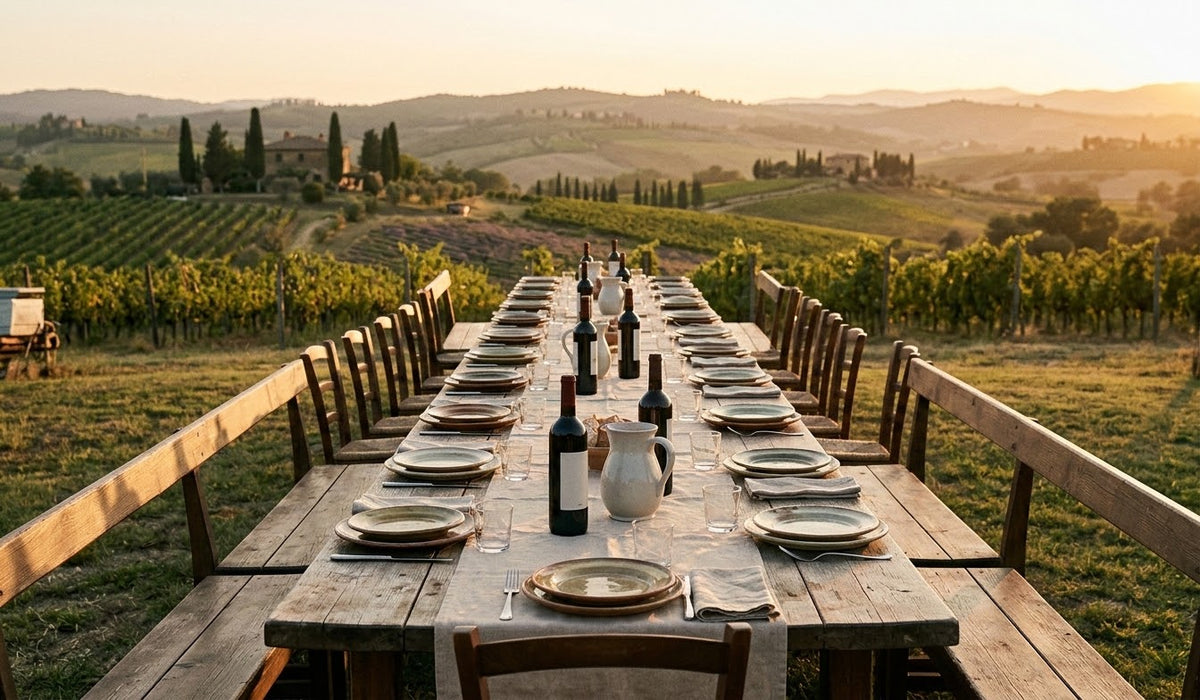
In villages throughout the Italian countryside, community is often built around food. Festivals celebrate seasonal harvests, and neighbors exchange recipes as a form of cultural currency. Local markets provide opportunities for conversation as much as commerce. Food becomes a common language served at a long table—a literal and metaphorical space for Genuinità (Authenticity). It creates opportunities for people to gather, share experiences, and strengthen relationships that might otherwise fade in the busyness of daily life. Perhaps this is why meals in Italy are often remarkably simple; the emphasis is rarely on complexity, but on the Gioia (Joy) of togetherness.

